
 Emergency Supplies
 Water Pumps
 Storage & Serving
 Cleaning
 Cast Iron
 Baking Supplies
 Canning
 USA Made
 Amish Made
 Order Catalog

Bezaleel means “under the shadow of God” and is the name of a school in Guatemala where Galen Lehman did volunteer work in July, 2008. #3 in a series of posts on what he learned there.
Most of the time I was in Guatemala, we were working members of the K’ekchi’ “culture group”. In North American terms, I suppose you would say they are the “K’ekchi’ Indians.”
They are direct descendants of the Maya, and have a strong and proud tradition. One of the most entertaining times we had was meeting with a K’ekchi’ elder, told us some of their legends.
According to tribal myths, corn was the food of the gods. One day, a mouse stole some seeds and hid them in his hole. A fox dug up the seed and ate it. When he excreted the kernels, they grew and flourished (fertilized, as they were, by the fox’s dung). That is their version of how corn came from heaven down to earth and how the Maya found it. To this day, corn is a mainstay of K’ekchi’ diet. We had corn tortillas at every meal.
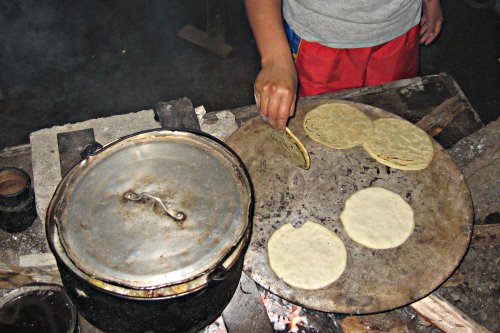
One of their traditional gods is the moon, whose changing phases were integrated into their calendar. We learned that tortillas are round and white, and baked on a round stone, as a reminder of “Mother Luna”.
 To us, those traditions seem silly. And, as the elder told us the stories, he laughed and winked as if we were sharing a good joke. It seemed that even he recognized that they no longer held value for his people in today’s world.
But, outmoded or not, traditions define who we are. Our connection to the past gives us security and a strong foundation in a world of shifting values. The K’ekchi family I stayed with (shown here) most assuredly did not believe the old Mayan god myths. But, they still made round corn tortillas at every meal on a round stone over an open fire, just the way they had been made for the last 2000 years.
Our host family had a traditional home made of wooden slats. There were no windows, but light streamed in through cracks between the boards. The floor was dirt. The roof was corrugated tin. Corn was planted on every square foot of land. A single faucet in front of the home provided running water. The bathroom was a latrine in the cornfield.
Within the last 10 years, they had gotten two things that dramatically changed their lifestyle: cell phones and electricity. One foggy morning, I was struck by how quickly a seemingly simple change like that can destroy old traditions.
As I drifted from sleep to awakeness, I wondered when it would be polite to get up. Soon, I smelled woodsmoke from the fire being kindled. Next, I heard the sound of tortillas being made in the far room. The K’ekchi’ make them by taking a ball of dough and slapping it from hand to hand to flatten it out. I never quite got the hang of it myself…I tried it one night, and sent everyone in the room into gales of laughter when my half-formed ball of dough flew off into a dark corner.
I knew that the sound of tortillas being made meant it was time to get up. But, I paused as my bare feet hit the cold floor and let my mind drift for a moment.
It wasn’t hard to imagine how the “slap, slap, slap,” of tortillas being flattened had been a comforting sound in that home for generations. I closed my eyes and listened to the rhythmic slapping, the crackling of kindling, murmured greetings and quiet laughter. I knew that these were the morning sounds of security, normalcy, a loving mother and family life in their home.
Suddenly, the blaring of a TV broadcasting the morning news drowned out the sound of tortilla being made. Moments later, the neighbor’s radio was blasting salsa music. I was jarred back to the real world.
Later, we gathered around the fire for breakfast on crude plank chairs that sat crookedly on the uneven dirt floor. Smoke drifted lazily up into the eaves and gradually spilled out through the cracks. The conversation alternated from Spanish to K’ekchi’ to broken English. Meanwhile, the teenagers ignored us adults and pounded out texts on their cell phones. I suppose they were planning the day with their friends.
Back home, my kids aren’t allowed to text at the table. We don’t even answer the phone when we are eating together. And, the TV is never turned on breakfast. We do this because we want family and home to be a sanctuary from the world. But, modern culture is coming so fast to the K’ekchi’ that they haven’t yet figured out how to respond to it.
I hope they learn to put limits on it before it undermines all lifestyle, values and ways.
And, my hope for my family and you and your family is that we have learned that lesson well, too.
Read about how the work Galen did in Guatemala wasn’t about the work Galen did in Guatemala, but about something far more important.
Learn more about Mennonite Central Committee, a non-profit relief organization.

0 Comments