
 Emergency Supplies
 Water Pumps
 Storage & Serving
 Cleaning
 Cast Iron
 Baking Supplies
 Canning
 USA Made
 Amish Made
 Order Catalog

Monday, Sept. 7, 2009
United Feature Syndicate
MARYJANE’S EVERYDAY ORGANIC
There’s something about gazing up into a starry night sky that is deeply soul stirring. The sight of all that infinite diamond-studded darkness has the power to erase the trappings of modern life, bringing us back to a more primal part of ourselves, a part that is still exuberantly wild.
Not so long ago, you could simply drive a few miles out of town after dark and find nighttime as nature intended it — silent shadows draping the landscape, a black canopy of limitless stars arching overhead.
Stargazing was the kind of experience that inspired wonder, providing people with a healthy sense of smallness in a universe so grand. I can’t even begin to count the number of times I have looked to the night sky to help me keep life’s chaos in check. Problems just seem to pale when set to starlight.
Depending on the night sky the way I do, I find my heart reaching out to those who are losing their connection to the stars — or have lost it altogether. Two-thirds of Americans live under skies so unnaturally bright that they can no longer see the Milky Way. Imagine growing up without seeing that spectacular sprinkling of stars that has inspired so many dreams and stories throughout the ages. Sadly, the view is now obscured by a hazy halo of urban light that astronomers call “sky glow.”
Thank goodness I’m not the only one who hopes to hold on to the precious pockets of natural night we have left. More and more, people are waking up to our need for night, realizing that too much light is actually a form of pollution. According to the International Dark-Sky Association (www.darksky.org/), light pollution is not only unsightly; it also has far-reaching adverse effects on air and water quality, wildlife populations and human health. Studies tell us that the stress of losing our natural cycles of light and dark can contribute to headaches, hormonal imbalances, sleep disorders and increased anxiety. And how about all of the wasted energy and expense drained by ultra-illumination? The Dark Sky Initiative (www.darkskyinitiative.org) reports that we burn 300 million lights and 5 million dollars nightly across the nation.
As a firm believer in every-little-bit-counts, I know that if you and I make changes in the way we light our own lives, a greater wave of change will grow. So here are a few small steps in the “night” direction.
Helping From Home
- Choose energy-efficient outdoor light sources for your home, and keep wattages as low as possible.
- Use shields on lights so that they cast light downward.
- Use motion detectors or timing devices.
- Place lights so that they don’t reflect off other surfaces. Even when shielded, lights that reflect off of pale walls, glass or water can glare into the night sky.
- Check out the International Dark-Sky Association’s “Quality Lighting” Web page for vendors of innovative, shielded fixtures that preserve the quality of the nighttime sky (www.darksky.org/).
- If you think the lights near you are having a harmful effect, contact your city council about local lighting ordinances. Darksky.org offers a “Getting Started” guide for initiating an outdoor lighting ordinance in your community.
Find A Dark Sky Near You
Are you feeling like you’ve lost touch with the wonders of the night sky? Don’t worry, they’re still within reach. There’s no way to pin down the distance you need to travel from a city to get the perfect dark sky view, so it may take some exploration to find a spectacular spot. Start with the nearest parks and nature preserves, and work your way father from the city limits if the sky is still too bright. Although it may seem counterintuitive, it’s often better to stick to lower altitudes — valleys and river bottoms — because the view from mountain tops may be affected by lights from more distant places.
In town, it’s easy to forget just how many minuscule points of light you can’t see. But when you blaze a trail away from the lights of civilization, the night sky will reward you with stellar stargazing opportunities. Two handy tools to bring along are a star-watching field guide and a planisphere. A planisphere is a circular star chart that can be adjusted to show the starscape for any latitude, time and date. You can hold the planisphere above your head with the “north” indicator pointing toward true north so that it’s easier to map the constellations. A variety of field guides and planispheres are available from Acorn Naturalists (www.acornnaturalists.com).
Create Your Own Low-Impact Lighting
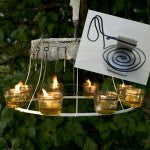
Instead of turning on an electric light when you’re out on the porch or patio enjoying the autumn evenings to come, try your own handmade oil lamp. An oil lamp burns brightly and lasts for hours, lending a charming glow that no bulb can replicate.
How to Make an Olive Oil Lamp
Here’s a simple project for a kerosene-type lamp made from any size canning jar and household olive oil. Olive oil is smoke-free and odor-free. You can add a few drops of your favorite essential oil to scent your lamp.
You’ll need:
- Wide-mouth canning jar (any size)
- 16-gauge flexible steel wire
- ½ to 1-inch braided flat wick (try www.lehmans.com or your local craft store)
- Olive oil
Take the flexible steel wire and form one end into a hook about the same height as the jar. Wrap the other end of the wire into a coil about 1½ inches tall. The coil will sit on the bottom of the jar to hold the wick and the other end will hook over the top of the jar to hold the coil in place and allow you to pull up the wick to light it. Put your wick into the coil with about ¼ inch sticking up above the coil and pinch the top of the coil to hold it. (The other end of the wick will soak in the oil.) Add oil to the jar to just under the pinched coil.
Copyright 2009, MaryJane Butters.
Distributed by United Feature Syndicate, Inc.


0 Comments