
 Emergency Supplies
 Water Pumps
 Storage & Serving
 Cleaning
 Cast Iron
 Baking Supplies
 Canning
 USA Made
 Amish Made
 Order Catalog

Lehman’s was founded by my father, Jay Lehman (1929 – 2020) to serve the local Amish community here in northeast Ohio. Dad greatly admired the Amish and their agrarian way of life and knowledge of practical, hands-on skills. The Amish, as you might know, live without electricity and are rooted in faith, tradition and family. Dad knew that without the products to sustain their connection to the land their traditions would be hard to maintain. After all, if no one is selling butter churns, then no one knows how to churn butter, right?
The year was 1955 and Dad was the only employee when Lehman’s opened.
He had borrowed money from his father, Ezra, to purchase what was then known at the AB Sommers Hardware, built around 1919 in the center of town. (If you’ve ever been to Kidron, you know that the center of town is, well, Kidron). AB had also sold to the local Amish and others without electricity and Dad continued that tradition by stocking wood heating and cooking stoves, oil lamps, hand tools and water pumps.
Dad eventually hired his father, as well as his brother Dave, his sister Pearl and long-time family friend Raymond. People may not realize that for many years, Lehman’s was a tiny local store and Dad worked long hours, six days a week.
What made Lehman’s different was Dad’s plan to KEEP selling the old-fashioned but brand new products that the Amish and local farmers used daily. He wanted to (my words, not his) Preserve the Past for Future Generations. He was concerned, rightly so, that the practical hands-on skills people knew would disappear if the younger generation didn’t learn them.
Side note: A few years ago, we were churning butter in the store as a demo for our customers. A little girl walked up with her grandmother and we explained that we were churning the fresh cream to make butter. They shopped for a bit and came back, just as we were pouring the buttermilk off so we could eat the butter on fresh-baked bread. “Oh, I missed it,” she exclaimed. “When did you put the butter in?” To her, where did butter come from – a plastic tub in the grocery store, right. This little girl’s grandmother likely wasn’t born when Dad opened Lehman’s 68 years ago, but that was an example of his mission being fulfilled!
As Lehman’s grew and attracted more visitors and tourists, the Amish turned to their relatives and smaller local vendors to purchase items they needed. While the amount of Amish that still shop at Lehman’s is likely similar to the number decades ago, the amount of non-Amish shoppers is over 90%.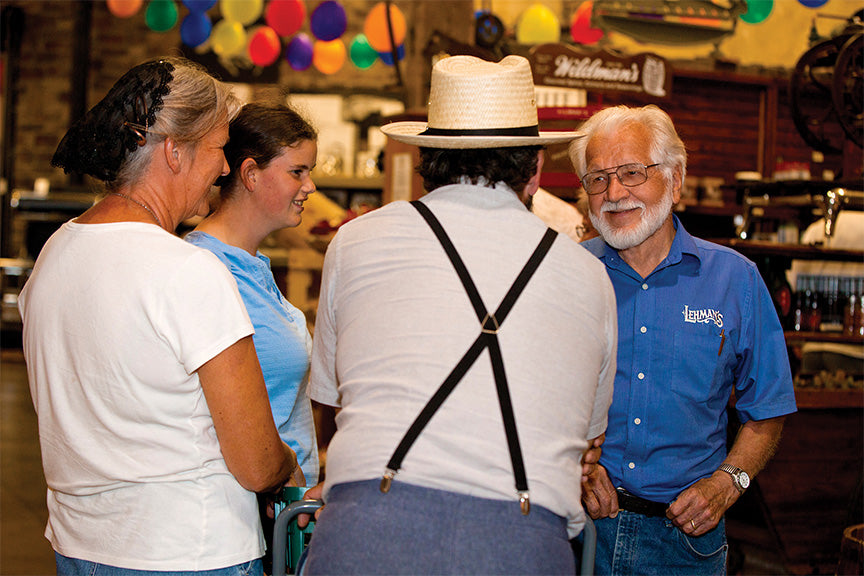
However, our connection to the Amish is still very strong. One Amish man told me his goal was to “put his feet under the table three times a day.” He meant enjoying breakfast, lunch and dinner at his home with his family. Most Amish people prefer working at home, so they can be “in the world, but not of the world.” Once they start working in English (what they call us non-Amish) businesses, their traditions and beliefs can be challenged. Since we have so many Amish vendors, we are giving them a chance to work at home. And perhaps more importantly, we are keeping the skills of leather, iron and wood working, sewing, and craftsmanship alive because they are teaching their children and grandchildren the skills that might otherwise have been lost. Additionally, most Amish aren’t allowed to use the internet for marketing and are happy selling us the product and letting us do the marketing.
Dad, who spoke fluent Pennsylvania Dutch, would often get in his pickup truck and drive out to the Amish farms, looking for new products. He would ask the first farmer if he made wooden wheels, for example. Perhaps not, but that farmer sent him up the road to another farmer that was making wheels who told him about an ax that a relative was making down the road. You get the idea.
So today, in 2023, we are still helping the Amish community maintain their way of life since they are able to work at home producing the tried and true products they have been using for generations.


0 Comments